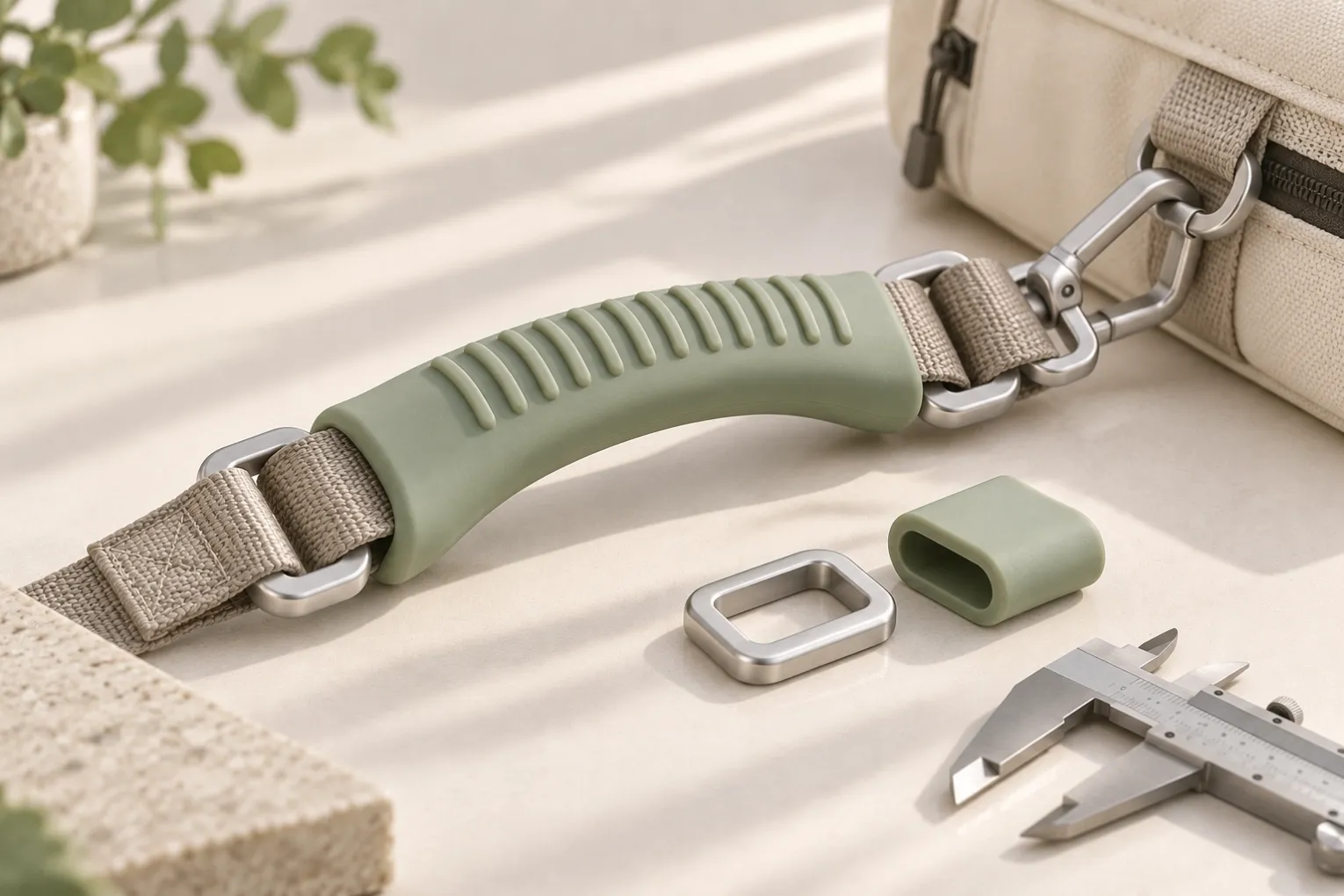
Functional outdoor carry accessories demand precise load-direction engineering, custom hardware tolerance fitting and non-slip surface grip rather than simple aesthetic customization.
In the outdoor and travel equipment sector, expectations have shifted from basic cosmetic accessories to engineered carry systems. For a combined silicone and metal or plastic hardware carry harness, relying only on custom colors and surface logo prints leads to product failure under real-world stress.
1. Engineering load direction in flexible elastomers
Silicone has strong tensile elasticity, but unreinforced elastomer structures stretch unevenly under dynamic motion. A functional carry system uses directional ribbing or variable wall geometry to control elongation under load.
Molded structural gussets redirect downward load toward the hardware connection points. Higher-durometer formulations (for example 60A to 70A Shore hardness) are commonly selected for load-carrying sections to limit permanent set; the right hardness depends on the load, section geometry and use pattern.
2. Precision tolerance fit between silicone & metallic hardware
Overcoming material discrepancies
Rigid metal carabiners hold their shape under load, while silicone flexes under friction. Tooling must account for differential thermal contraction during molding, and the fit is confirmed on molded samples rather than assumed from the drawing.
3. Micro-textured surface grip for active travel environments
Smooth silicone becomes slippery when exposed to moisture, rain or sweat. Molded tactile textures such as matte micro-beading or geometric cross-hatching increase static friction; how a texture performs in wet, sweaty or dusty conditions should be confirmed on samples.
4. DFM and production support
ESKY SUPPLY conducts Design for Manufacturability (DFM) evaluations for custom molded carry components. Load expectations, hardware interfaces and tolerance requirements are reviewed before tooling, and prototype samples confirm fit and feel before repeat production.
Engineer your custom outdoor carry system
Partner with ESKY SUPPLY for DFM analysis, prototype samples and custom tooling for silicone carry systems.
Commonly referenced standards
ASTM D412 - standard test methods for vulcanized rubber and thermoplastic elastomers: tension.
ISO 37 - rubber, vulcanized or thermoplastic: determination of tensile stress-strain properties.
ISO 3302-1 - rubber: tolerances for products, part 1 (dimensional tolerances).
DIN ISO 2768-1 - general tolerances for linear and angular dimensions.