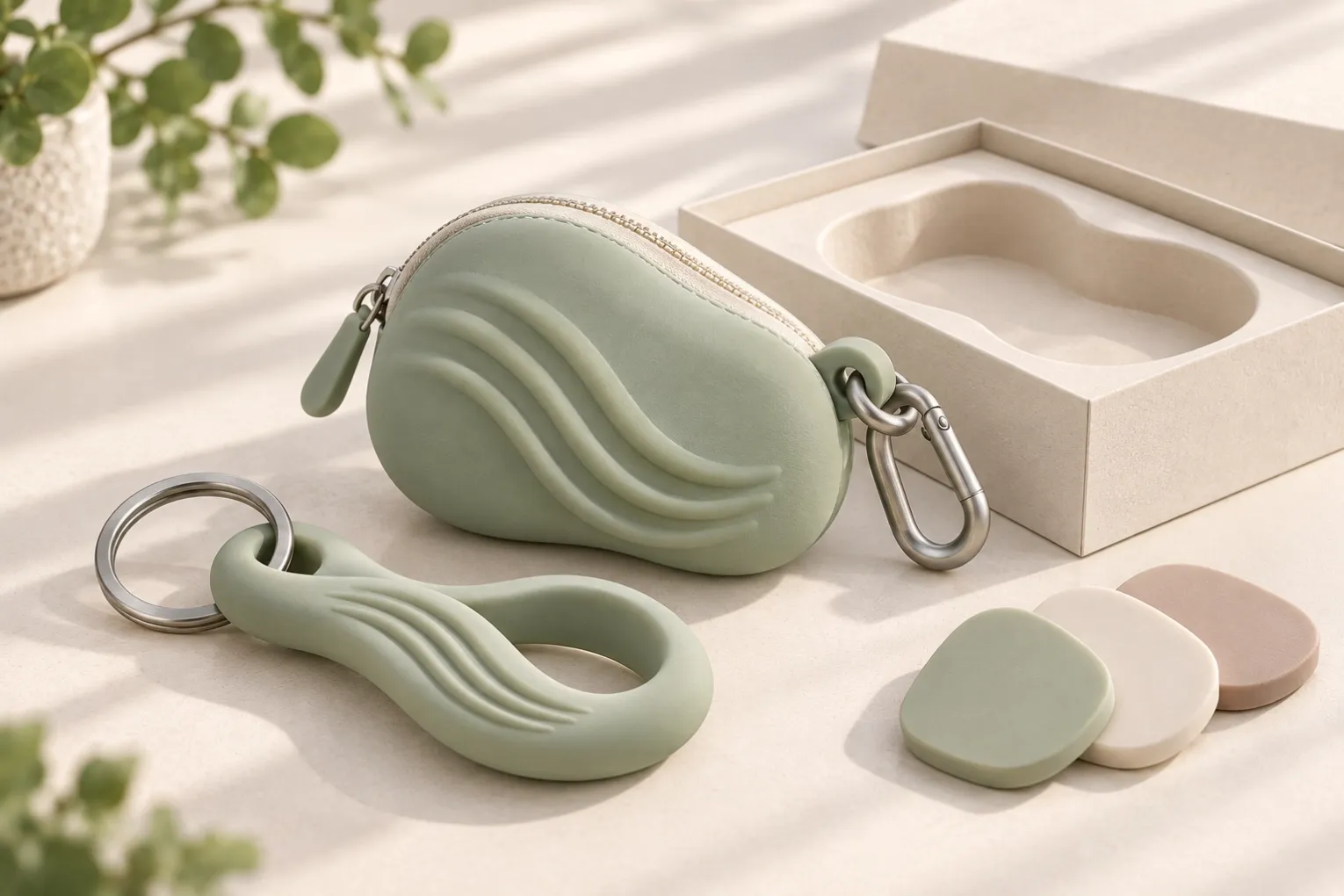
Learn how retail and promotional brands transition from generic catalog items to fully custom silicone shapes, proprietary hardware, tailored Pantone-referenced colors and custom packaging.
In the promotional products and branded merchandise sector, relying on generic catalog items with simple screen-printed logos often results in commodity competition and low perceived value. Transitioning from off-the-shelf products to bespoke silicone tooling allows lifestyle and corporate brands to build differentiation and stronger brand equity.
1. Proprietary molded shapes & 3D tactile branding
Screen printing on silicone can rub off over time under heavy daily friction. Custom tooling allows brands to integrate identity elements directly into the mold geometry instead of applying them to the surface.
Embossed and debossed details: precision CNC tooling creates high-definition 3D logos and patterns that are molded into the part itself, so the branding lasts as long as the product.
Bespoke geometry: designing original silhouettes instead of standard circular or rectangular formats sets merchandise apart on retail shelves.
2. Integrated hardware & material combinations
Elevating utility with custom hardware
Combining soft silicone with zinc alloy carabiners, stainless steel key rings or custom-molded ABS buckles turns simple keychains and accessories into durable, premium everyday-carry gear.
3. Pantone-referenced color matching & surface finishes
Consistency across touchpoints is vital for brand recognition. Liquid silicone processing supports Pantone-referenced color matching, multi-color molding, marbled effects and soft-touch matte coatings. The achievable match should be confirmed on molded samples rather than paper references alone.
4. Retail-ready packaging & cohesive unboxing
Bespoke merchandise requires presentation that matches product quality. Custom hangtags, paper boxes and clear window packaging protect silicone items during shipping and support a cohesive unboxing experience.
5. End-to-end custom tooling
ESKY SUPPLY provides OEM silicone manufacturing services for merchandise brands: DFM analysis, custom tooling, prototype sampling and repeat production bring custom merchandise concepts to life.
Create custom branded silicone merchandise
Partner with ESKY SUPPLY for custom tooling, Pantone-referenced color matching and retail packaging solutions.
Commonly referenced standards
ISO 2813 - paints and varnishes: determination of gloss value.
ASTM D2240 - standard test method for rubber property, durometer hardness.
CPSIA Section 101 - total lead content requirements; applies to children's products and their component parts, not to all consumer products.
EU Regulation (EC) No 1907/2006 - REACH compliance for consumer accessories.
Merchandise platforms we develop
- Character 3D charms, figurines & keyrings — 2D mascot artwork converted into tactile 3D objects, integrating with zinc-alloy clips, stainless-steel rings or woven lanyard straps.
- Silicone straps, tethers & wearable accessories — flexible elements engineered for load-bearing use, with internal reinforcement ribs for tensile strength at attachment points.
- Functional tech & lifestyle gear — silicone as a protective, soft-touch housing combined with plastic, metal or electronic modules in one unified part.
Modular architecture for multi-SKU campaigns
To launch across regions without cutting unique tooling for every variant, a modular framework helps: keep a standardized functional base (for example a metal loop or housing) and swap low-cost, character-specific silicone sleeves, charms or colour inserts. Snap retention tolerances and pull-force thresholds are reviewed at DFM so modules stay attached in use.
Translating 2D artwork into moldable tooling
Converting vector mascot artwork into production tooling requires specific adjustments:
- Parting lines along natural contours — placed to keep flash marks off critical facial features.
- Colour boundary isolation — isolation dams between colour zones in multi-color molds prevent pigment bleeding.
- Wall thickness uniformity — consistent cross-sections (typically around 1.2–2.5 mm) avoid sink marks and curing variation.
Validation for licensed & character products
Character and licensed items may need physical evaluation before retail distribution: pull and tensile testing of attachment points and loops, swap-cycle testing on modular snap interfaces, and small-parts compliance review against the applicable toy/consumer safety requirements for the target market. Scope is confirmed per program.
Multi-material assembly notes
Combining silicone with rigid components adds considerations: mechanical interlocking (undercut grooves or internal anchors) where chemical primers are omitted, substrate temperature limits when choosing the molding route, and dielectric spacing between embedded electronics and metal hardware where scanning or signal performance matters.
Lead times & milestone delivery
Event deadlines and retail launches are protected with structured milestones: pilot tooling and golden samples validate colour accuracy, assembly fit and packaging before mass production, and late-stage customization keeps unbranded core hardware in stock with custom silicone sleeves molded close to the campaign date.
Ready to move? Send your artwork, product list and requirements through the Contact page — the Products page shows the product families we develop and what we need to start a review.