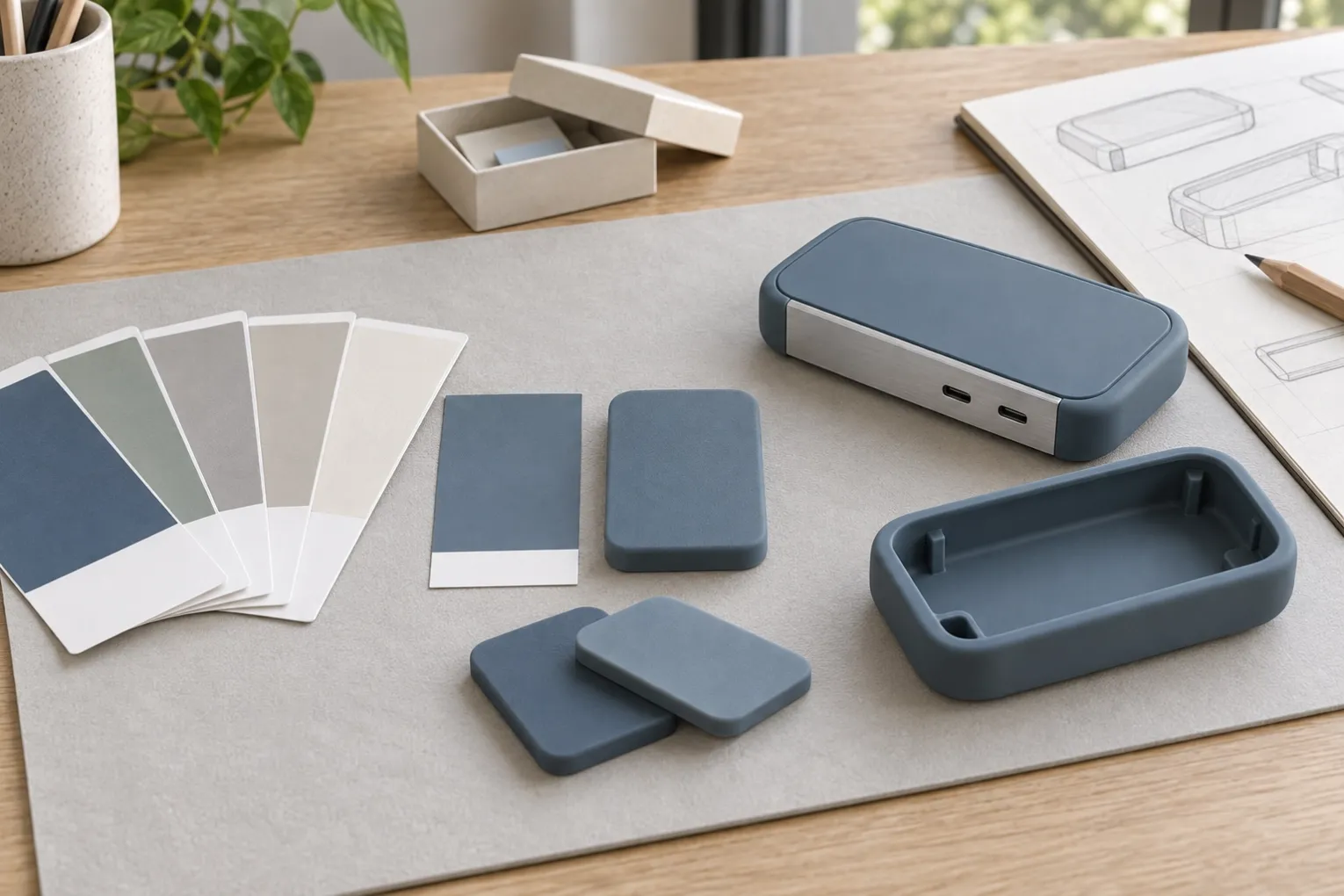
Specifying a Pantone (PMS) code is the standard starting point for corporate branding, merchandise design, and consumer product lines. However, when working with silicone elastomers, a Pantone code is a visual reference target—not a complete engineering specification.
Silicone is fundamentally different from coated paper or rigid thermoplastics. Achieving consistent color reproduction across production batches requires controlling high-temperature curing cycles, pigment masterbatch dispersion, wall thickness variations, and surface finishes. Without a defined approval process, significant color discrepancies can occur between initial design sign-off and mass production.
1. Why Pantone Is a Target—not a Finished Silicone Specification
Pantone Matching System (PMS) formula guides are printed on paper using ink. Liquid silicone rubber (LSR) and solid high consistency rubber (HCR) are semi-translucent polymers cured at high temperatures. As a result, direct physical matching to a paper swatch presents inherent material limitations:
- Base Translucency: Raw silicone naturally diffuses light, which alters perceived color depth compared to opaque printed paper.
- Thermal Pigment Shift: Platinum and peroxide catalyst systems induce chemical reactions at temperatures exceeding 160°C–180°C, which can slightly alter heat-sensitive organic pigments.
- Refractive Index Differences: Light absorbs and refracts differently inside an elastomeric matrix than on flat ink on paper.
2. How Silicone Grade, Pigment and Cure Affect Colour
The raw silicone formulation and curing mechanism directly dictate color fidelity:
- LSR vs. HCR: Liquid Silicone Rubber (LSR) uses liquid color paste metered directly into the injection barrel via automated dosing units, providing exceptionally uniform dispersion. Solid Rubber (HCR) relies on two-roll mill compounding of solid color masterbatches, where operator consistency and milling time impact color distribution.
- Curing Catalyst (Platinum vs. Peroxide): Platinum-cured silicone provides superior clarity and zero yellowing, making it ideal for pastel shades, bright whites, and medical-grade parts. Peroxide-cured silicone can introduce a faint yellowish tint during vulcanization, which must be counterbalanced during color compounding.
3. Thickness, Texture and Geometry Change Visual Appearance
A single batch of silicone compound will appear visibly different when molded into varying wall thicknesses or surface finishes:
- Wall Thickness Variation: Thinner sections (e.g., 1.0 mm) allow more light transmission, appearing lighter than thicker structural sections (e.g., 4.0 mm) molded from the exact same batch.
- SPI / VDI Surface Finish: High-gloss polished cavities (SPI-A2) reflect light directly, making colors look richer and darker. Textured or matte cavities (SPI-C1 / VDI 24) scatter light, creating a lighter, more desaturated appearance.
4. Lighting, Background, Metamerism and Measurement Conditions
Color perception changes dynamically depending on the evaluation environment. A common engineering challenge is metamerism—where two color samples match under one light source but differ under another.
Standardizing Color Inspection Protocols
To eliminate subjective disputes, color evaluations should be performed inside a standardized light booth using D65 (Daylight) as the primary standard, alongside TL84/F11 (Store Lighting) or A (Incandescent). Samples must be evaluated against a neutral gray background (N7 or N5) to prevent background color bleed.
5. Printed, Laser-Marked and Molded Logos
Branding execution on silicone substrates requires specific color alignment strategies depending on the process:
- In-Mold 3D Logos: Raised (embossed) or recessed (debossed) logos share the base component's color. Visual contrast relies entirely on shadow lines created by draft angles and depth.
- Silicone-Based Screen / Pad Printing: Printing on silicone requires specialized silicone-based inks that chemically bond to the substrate during secondary oven curing. Ink opacity must be adjusted when printing light colors on dark silicone bases.
- Laser Marking: Laser etching alters the surface texture or removes a top coat layer, which inherently produces monochromatic or contrast marks rather than precise PMS matches.
6. Heat, Dishwasher, UV and Cleaning-Aging Checks
Initial color approval does not guarantee long-term color stability. Environmental stress testing must be defined based on the product's end-use conditions:
- Thermal & Dishwasher Resistance: Consumer kitchenware or baby products must undergo repeated high-temperature washing cycles to verify pigment fastness and anti-blooming performance.
- UV Exposure & Weathering: Outdoor accessories require UV-stabilized pigments to prevent yellowing, chalking, or fading under prolonged sunlight exposure.
- Chemical & Sweat Exposure: Wearables and lifestyle accessories require synthetic sweat and cleaning solvent resistance testing to prevent color migration or surface degradation.
7. Packaging Contact, Staining and Surface Rub
Pigment transfer and surface contamination can occur post-manufacturing during storage and transport. Color quality protocols must verify:
- Color Migration & Rub Off: Dry and wet crocking tests ensure pigments do not rub off on clothing or skin.
- Packaging Material Compatibility: Direct contact with unlined corrugated cardboard or low-grade polybags can cause plasticizer migration or staining on light-colored silicone parts.
8. Master Plaque, Actual-Part Sample and Golden Sample
Relying solely on paper swatches for mass production sign-off leads to quality risks. ESKY SUPPLY executes a structured three-tier approval workflow:
| Approval Stage | Sample Type | Primary Purpose |
|---|---|---|
| 1. Color Verification | Flat Master Color Plaque (2.0 mm) | Validates raw material pigment formulation against target PMS code under standard lab conditions. |
| 2. Engineering Validation | Actual-Part Pre-Production Sample (T1/T2) | Evaluates color under actual product geometry, wall thickness, and mold texture. |
| 3. Production Standard | Golden Sample (Physical Sign-off) | Serves as the binding physical reference for limit samples (upper/lower delta limits) during mass production QA. |
9. Batch Records, Tolerances and Change Control
Because physical elastomeric production exhibits slight batch-to-batch variation, acceptable color tolerances must be established before mass production:
- Delta E (ΔE) Spectrophotometer Metrics: Depending on the application, strict brand-critical components may require a ΔE < 1.0 to 1.5 (CIE Lab* standard), while general commercial parts operate within ΔE < 2.0 to 2.5.
- Traceable Batch Records: Raw masterbatch dosing ratios, mill mixing logs, and cure temperatures are documented per production lot to ensure repeat order consistency.
10. What to Include in a Colour-Critical Silicone RFQ
To receive an efficient DFM and color feasibility review, include the following parameters in your inquiry package:
- Target Pantone (PMS) code and primary viewing light source (e.g., D65).
- Base silicone requirements (LSR vs. HCR, Shore A hardness, FDA/LFGB compliance).
- Surface finish specifications (SPI mold texture standard).
- Logo application method (molded, silk-screened, or laser-marked).
- Environmental exposure requirements (UV, dishwasher, elevated temperature).
Developing a Colour-Critical Silicone Product?
Send your target Pantone, material requirements, part geometry, logo method, and use conditions for an initial color-and-manufacturability review.
- ASTM D2244 - Standard Practice for Calculation of Color Tolerances and Color Differences from Instrumentally Measured Color Coordinates (CIE Lab*)
- ASTM D1729 - Standard Practice for Visual Appraisal of Colors and Color Differences of Diffusely-Illuminated Opaque Materials
- ISO 105-A02 - Tests for colour fastness -- Part A02: Grey scale for assessing change in colour
- SPI Mold Finish Standards - Society of the Plastics Industry Mold Surface Finish Classifications (SPI A-1 to D-3)
- FDA 21 CFR 177.2600 / LFGB - Safe extraction thresholds for colorants and pigments used in food-contact rubber