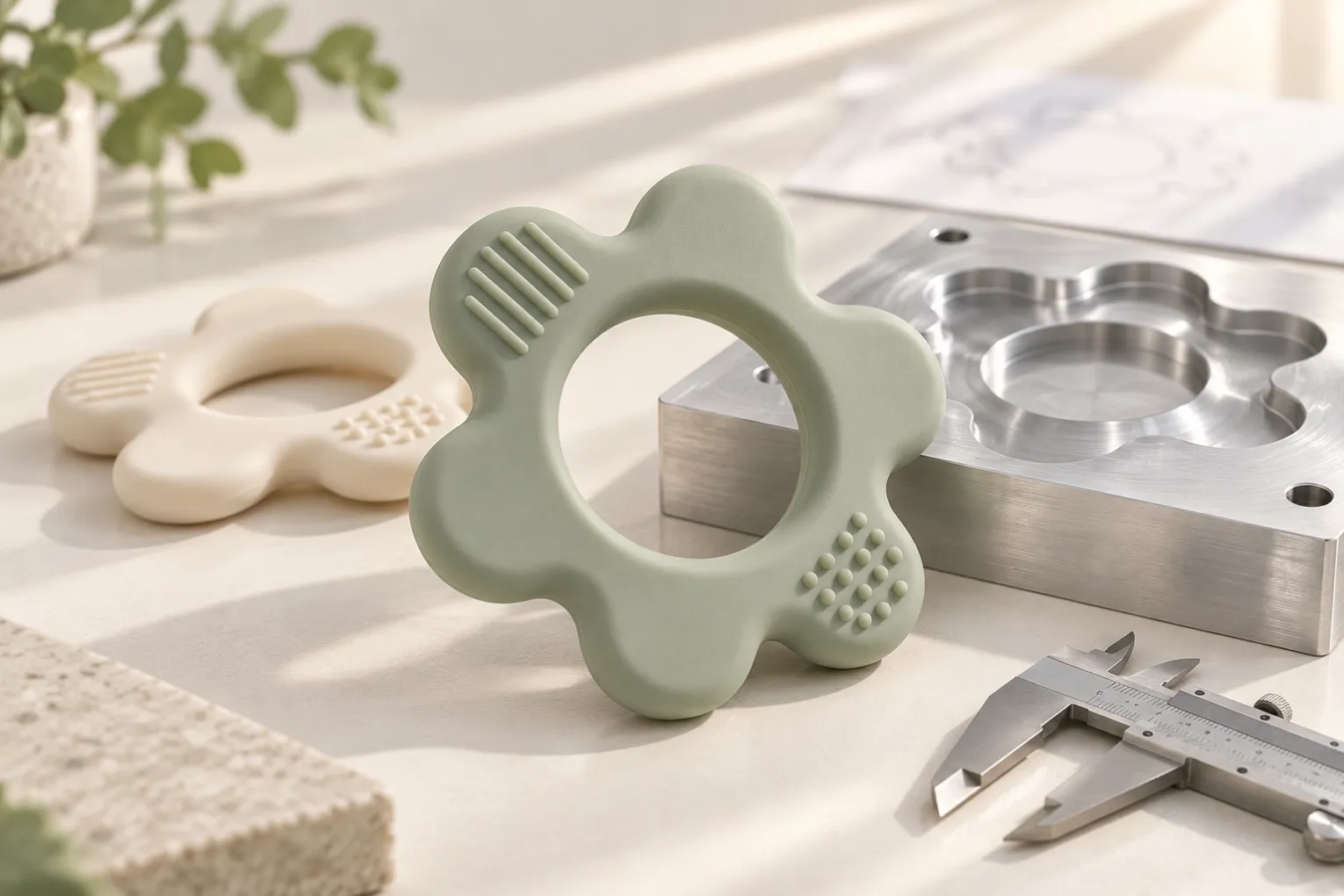
In infant care product development, passing raw material testing such as FDA food-contact compliance (FDA 21 CFR 177.2600) or European LFGB is often treated as the milestone that clears a teether for market. Real-world field performance tells a different story: material compliance is the entry ticket, not a guarantee of finished-product safety. Structural integrity, joint strength, clearance under oral deformation and manufacturing stability decide whether a silicone teether holds up in use.
1. Material compliance vs. finished-product safety
Product teams should distinguish chemical material testing from mechanical-physical toy safety standards. Chemical and material compliance (FDA 21 CFR 177.2600, LFGB, REACH) validates that the cured silicone does not leach harmful substances into saliva. It is essential for biocompatibility, but it provides no assessment of structural durability.
Finished-product physical and mechanical safety (CPSC requirements, ASTM F963, EN 71-1) evaluates how the complete product behaves under mechanical stress, bite forces, dynamic tensile loading and repeated compression, including small-parts detachment risks.
Engineering reality: a compliant LSR formulation that is improperly molded, under-cured or joined with weak mechanical bonds can tear under an infant bite force and create a choking hazard. Toxicity safety does not equal structural safety.
2. Common failure modes in teether design
Field failures in multi-component infant teethers tend to follow two patterns.
Mechanical separation of multi-material assemblies: overmolded silicone on rigid frames can debond after repeated washing, sterilization or mechanical fatigue, allowing small soft elements to detach from the core structure.
Geometric hazards: long, thin protruding features such as legs, tails or narrow handles can pose airway and choking risks when they compress or bend, even when they do not detach.
Toy safety standards such as ASTM F963 and EN 71-1 address these risks through tension and compression tests and small-parts cylinders. Always work to the current edition of the standard that applies to your target market.
3. Designing out detachable small parts
The most effective way to reduce small-parts risk is during the initial Design for Manufacturability (DFM) phase, not through downstream quality sorting.
One-piece silicone construction
Whenever the geometry permits, mold the teether as a single continuous silicone structure by LSR injection molding or compression molding. One-piece construction removes glue interfaces, snap-fits and overmolding bond lines - and with them the detachment risks those joints introduce.
Reducing risk in multi-material designs
If the concept requires a rigid core overmolded with silicone, design physical interlocks - through-holes, undercut grooves and T-slots - so the silicone anchors mechanically through the substrate instead of relying on adhesion alone. A uniform overmold wall thickness with generous corner radii also helps prevent tear initiation at sharp substrate edges.
4. Building real-use conditions into validation
Laboratory testing often simulates ideal conditions. Infant teethers endure washing, sterilization, steam, sunlight and chewing fatigue before mechanical failure appears. Validation should include the environmental stressors the product will actually encounter in its service life.
5. Material records and production controls
Consistent production matters as much as safe design. Baseline controls for infant-contact silicone products include traceability from raw material lots through molding and post-curing records, controlled post-curing to reduce residual volatiles, and inspection of parting lines so that flash and thin excess edges do not reach the customer.
6. A DFM checklist before silicone tooling
Before committing to tooling, confirm: one-piece versus multi-material construction; interlock geometry for any overmolded joint; wall thickness and corner radii; material selection and the certifications your target market requires; a validation plan covering real-use conditions; and the technical documentation your market expects.
Partner with experts in silicone engineering & DFM
Working on a silicone-molded product that must meet strict safety and validation requirements? Send your concept, CAD model or technical drawing for a manufacturability and structural DFM review before tooling.
References
U.S. Consumer Product Safety Commission (CPSC) toy safety requirements, including the small parts test in 16 CFR Part 1501. Note that 16 CFR Part 1511 covers pacifiers, which are regulated as a different product category from teethers.
ASTM F963, current edition - Standard Consumer Safety Specification for Toy Safety, including teether requirements.
UK Office for Product Safety and Standards (OPSS) product safety and recall framework.
ISO 8124-1 - Safety of toys, part 1: mechanical and physical properties.