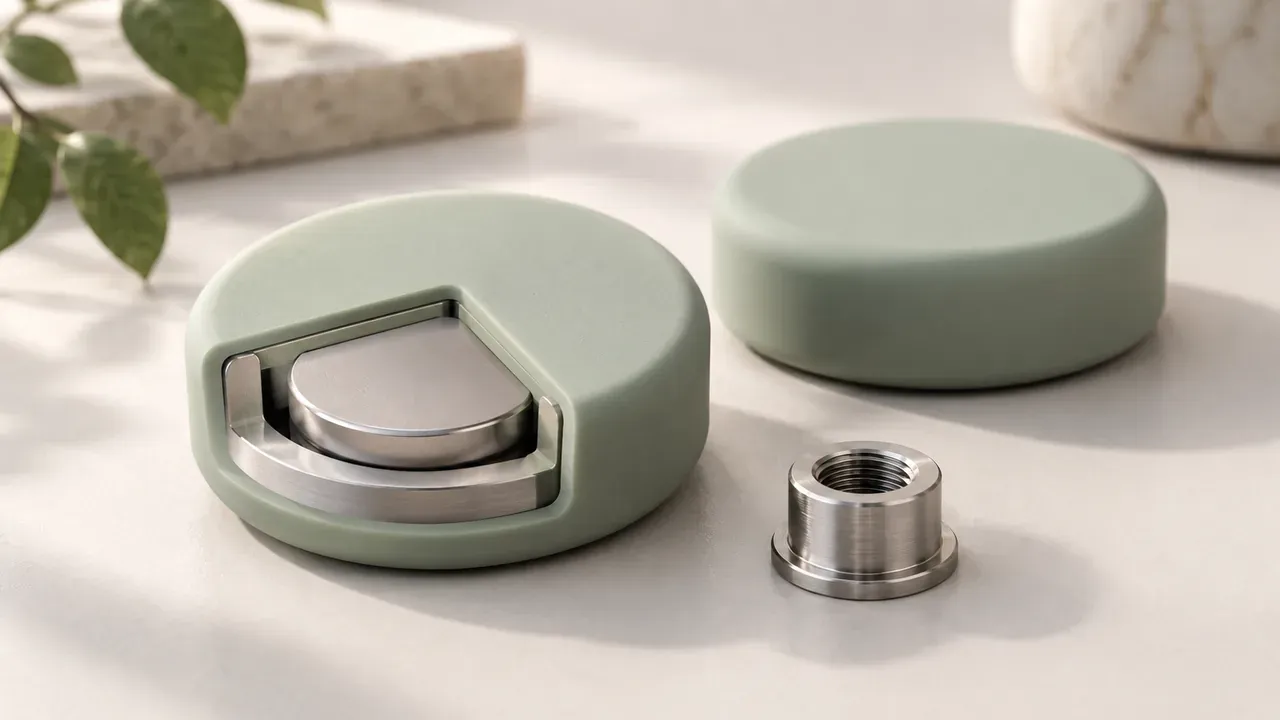
Metal inserts are commonly added to silicone parts when a product needs strength, threaded hardware, magnetic function, electrical connection or a rigid mounting feature.
The molding challenge is not simply putting metal into a silicone mold. The insert must remain stable, bond reliably and survive the curing process.
1. Surface condition matters
Metal surfaces may be bare, plated, anodized, polished or coated. Each surface behaves differently during bonding. Oil, oxide, release residue or handling contamination can reduce adhesion.
2. Insert positioning must be repeatable
Movement can cause uneven silicone thickness, dimensional error, exposed metal, flash and misalignment. Locating features should be designed into the tooling wherever possible.
3. Magnets need special attention
Important questions include magnet grade, temperature tolerance, coating, orientation and how the magnet is retained during molding. The thermal cycle should be reviewed before production so magnetic performance is not compromised.
4. Bonding strategy
Possible routes include chemical bonding, primer, surface activation and mechanical retention. For repeated flexing or high peel loads, adding mechanical retention can reduce stress on the bonded interface.
5. Watch for delamination
Delamination often starts where the silicone edge is thin, the interface is repeatedly peeled, the metal surface is poorly prepared, or the molded silicone is placed under residual stress.
6. Control flash around hardware
Metal inserts frequently create narrow shut-off areas. The mold must prevent silicone from flowing onto threads, electrical contacts, pin surfaces or cosmetic metal faces.
Have a silicone + metal or magnetic component? Send the insert drawing for a DFM review.